




![3[22410].jpg](https://images.squarespace-cdn.com/content/v1/6143cf06eb6b5548a6c139c5/064db0b8-2827-4259-8993-4243d1d20ab9/3%5B22410%5D.jpg)




At Malki Studio, our artistry is deeply rooted in Jewish and Israeli heritage, weaving together millennia of tradition, symbolism, and storytelling. Each handmade piece reflects the beauty, strength, and resilience of our people, seamlessly blending ancient motifs with contemporary design.
Our inspiration comes from the rich tapestry of Jewish art and culture—from the delicate filigree of the Middle East and North Africa to the ornate elegance of European Judaica. Every piece we create carries meaning beyond aesthetics, embodying symbols that have endured through generations.
As a family-owned business, we cherish the values of continuity and connection. Just as Jewish traditions are passed down with love and intention, we craft heirloom-quality pieces that tell stories of faith, identity, and heritage. Whether capturing the warmth of timeless blessings or the deep significance of ancestral symbols, our jewellery is designed to inspire, uplift, and connect.
Malki Studio creates jewellery that celebrates history, family, and the enduring spirit of the Jewish people.
Shop our Judaica Collection
Cuff Bracelet: responsibly sourced sterling silver, patinated copper (varnished), ethically sourced 6.37ct Brazilian lemon quartz (concave cushion-cut).
Path to Alon is a one-of-a-kind cuff bracelet inspired by the Arava Desert landscape that stretches between the Dead Sea, the lowest land elevation on Earth, and the Red Sea to the south. This desert runs along the Jordan Rift Valley that separates the African and Arabian tectonic plates. Growing up in this place, Path to Alon recalls the colourful rocky ridges that flank the narrow rift valley on both sides, the dried riverbeds that occasionally flood powerfully, and the unspeakable beauty of this part of the world.
The engraving and richly coloured patina of the bracelet’s copper body has been varnished to prevent the colour from changing and exposure to the skin. A thick outline of sterling silver solidifies the structure of the cuff and lends it light, while the stunning concave cut lemon quartz rises like a crown above the main body of the bracelet.
This piece was selected for artisan Collects (2022), a collaborative initiative between Malki Studio and artisan Gallery that invited collectors to explore jewellery as an art form. For more information, please click here.
Made to fit a medium to large sized wrist (reasonably adjustable).

Brooch: responsibly sourced sterling silver, heat coloured titanium, ethically sourced 4.46 carat white topaz from Mount Surprise, Queensland.
The fig tree is one of the first plants mentioned in Bereshit (Genesis) in the Torah, when its leaves were used by Adam and Eve in the Garden of Eden to clothe themselves immediately after eating of the Tree of Knowledge (suggesting that perhaps the Tree of Knowledge was a fig tree). Fig trees are also one of the Seven Species—a group of edible plants mentioned in the book of Dvarim as natural endowments of the land of Israel. Alongside wheat, barley, grapes, pomegranates, olives, and dates, the fig was considered by the Ancient Jewish Kingdoms and the Israelites as staples of their diet. The first fruits of the Seven Species were also used as offerings traditionally given to the Jewish Temple in Jerusalem by worshippers—the wood of the fig tree serving as fuel for the Temple’s Eternal Flame. In the Ancient Jewish holiday of Tu Be’Shvat, also known as the New Year for Trees, dried figs are traditionally eaten as part of the celebration.
These are but some of the significances of the fig tree to the Jewish people. That the native species of the Levant are so enmeshed within the foundation of Jews as an ethnoreligious group speaks strongly to our connection to the land of Israel. This brooch is an homage to that connection.
Eden was exhibited as part of the Intimate Worlds exhibition at NorthSite Contemporary Arts in Cairns. Occurring between August and October in 2024, the exhibition “is about celebrating materiality and process. The artists featured in ‘Intimate Worlds’ have a profound respect for their materials, and their work reflects a deep curiosity and dedication to their craft.”
Dimensions: 15.5 × 11cm (approximately 6.10 × 4.33 inches).
*Please note that the titanium pin that fastens this brooch is 1.5mm thick and therefore works best on looser woven fabrics.

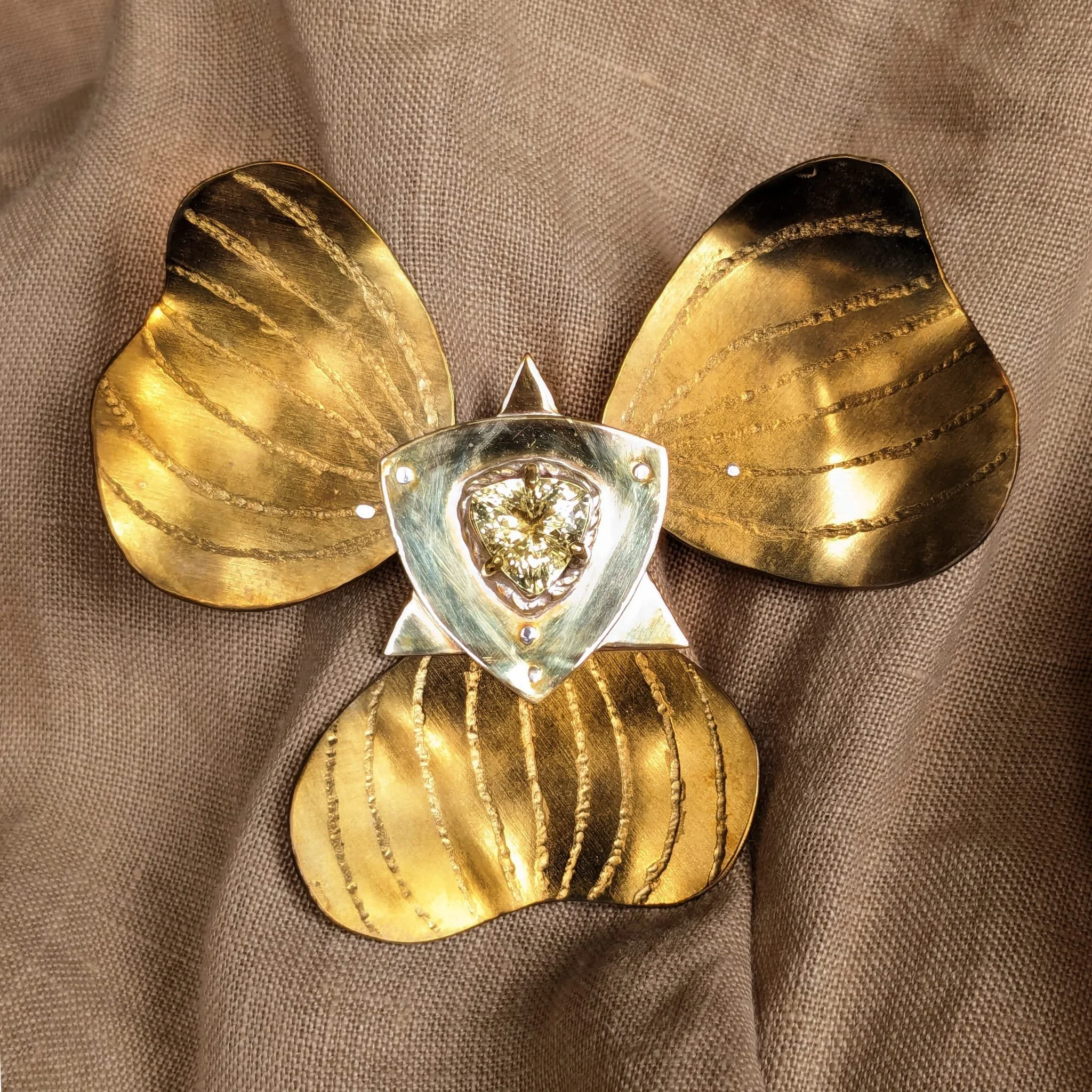
Brooch: responsibly sourced 18 karat gold, responsibly sourced sterling silver, heat coloured titanium, responsibly sourced fine silver, ethically sourced 2.4 carat London blue topaz from Brazil.
The Nova brooch was made in response to the October 7th massacres that occurred in Israel, in particular the Nova Music Festival. Nova takes the form of a flower, a purple variant of the poppy anemone which is native to the Mediterranean region which includes Israel. The poppy anemone is Israel’s favourite flower, the red variant being Israel’s national flower. Following the massacre at the Nova Music Festival, the Israeli community has created individual memorials for those who were murdered, including planting flowers that honour the dead. Not surprisingly, a favourite among these has been the poppy anemone, or Kalanit (in Hebrew).
Malki Studio has created this brooch to express the ongoing grief of Jewish and Israeli people, and offer it as a solemn example of our people’s deep connection to our land, culture, history, religion, and each other.
Nova was exhibited as part of the Intimate Worlds exhibition at NorthSite Contemporary Arts in Cairns. Occurring between August and October in 2024, the exhibition “is about celebrating materiality and process. The artists featured in ‘Intimate Worlds’ have a profound respect for their materials, and their work reflects a deep curiosity and dedication to their craft.”
Brooch dimensions: approximately 7cm x 7.5cm x 3.5cm.
*Please note that the titanium pin that fastens this brooch is 1.5mm thick and therefore works best on looser woven fabrics.

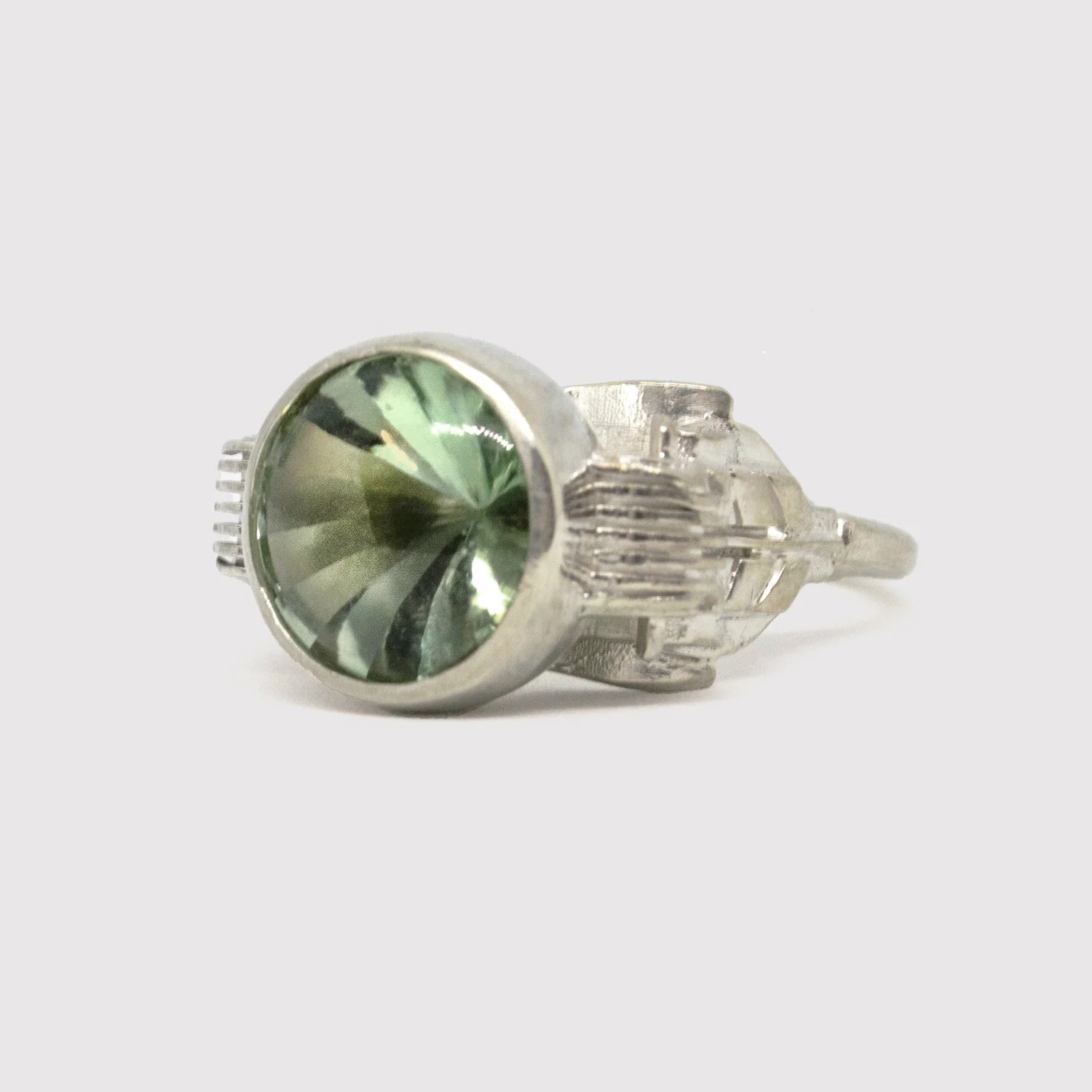
Ring: responsibly sourced sterling silver.
This unique ring is part of our Ancient Tomorrow Collection. It combines ancient and contemporary aesthetics through the fusion of ornate silver casting and minimalist fabrication techniques. The piece is inspired by antique European Jewish wedding rings, which (in contrast to other Jewish traditions) were often shaped as buildings with a cupola to represent the ruined Jewish Temple, the synagogue, and as a symbol of the marital home.
This piece was selected for artisan Collects (2022), a collaborative initiative between Malki Studio and artisan Gallery that invited collectors to explore jewellery as an art form. For more information, please click here.
Size: (resizable) Z +1 1/2 (13.25). See our Sizing Guide.
Dimensions: 2.6cm x 4.7cm x 2.3cm.
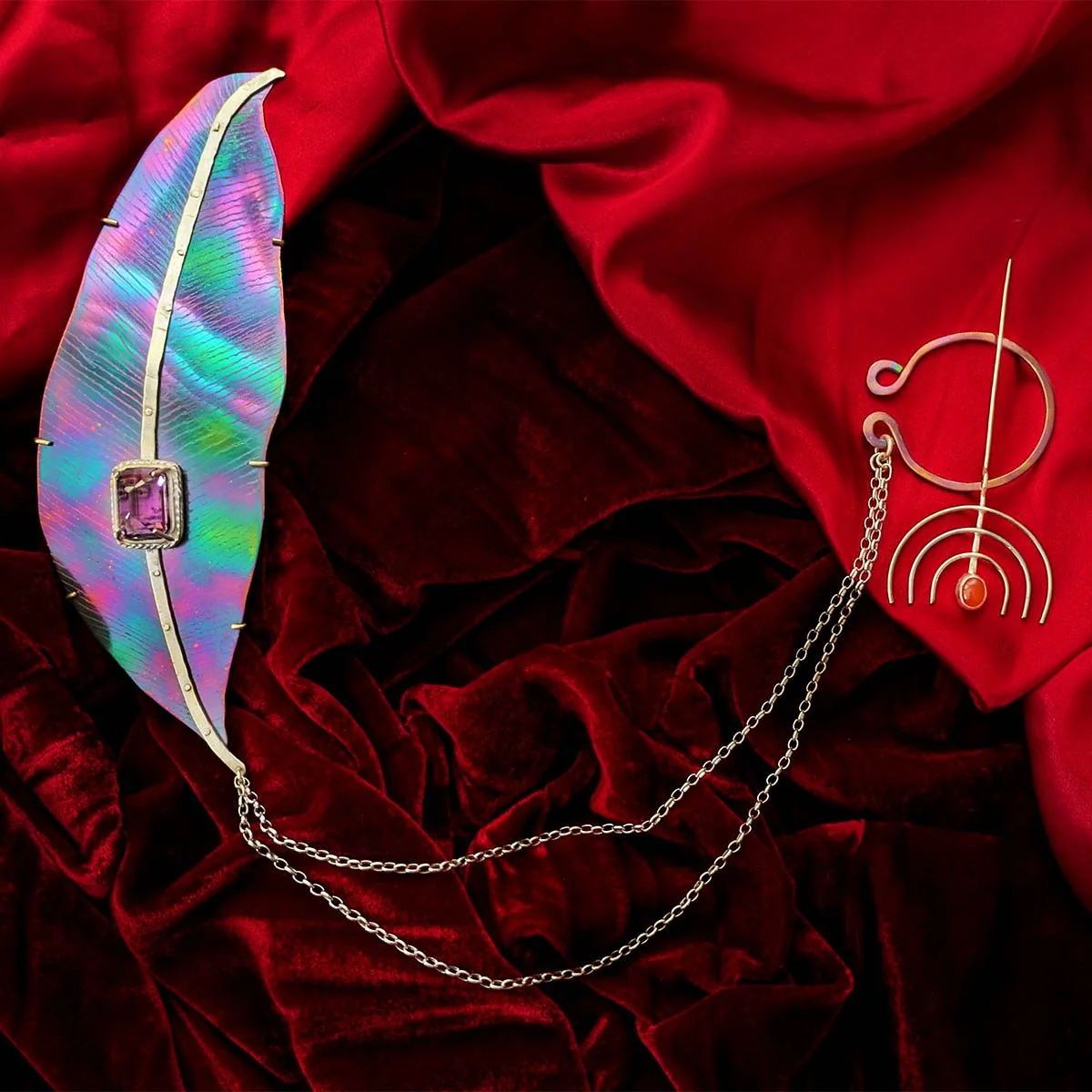
Brooch and fibula: responsibly sourced sterling silver, heat coloured titanium, emerald cut 12.78 carat Bolivian amethyst, carnelian cabochon, acrylic paint on linen, varnish, sterling silver chain.
Karti is essentially composed of two pins which are attached through a chain. Its name is a reference to one of the prayers and symbols of the Jewish New Year (Rosh Hashana), which represents divine protection from the malevolent forces that threaten the Jewish people.
Karti was made in the immediate aftermath of the October 7 massacres in Israel, and speaks especially of the strength of Jewish women.
Its design cites the traditional jewellery produced and worn by Jews in North Africa prior to our ethnic cleansing in the middle of the 20th Century. Traditionally, Jewish women would have worn two fibula brooches—one on each shoulder—which fastened garments. A chain traditionally connected between the brooches and suspended beads or other ornaments with various symbolic meanings.
In Karti, the fibula takes the form of an inverted Menorah, an ancient symbol of Jewish continuity, set with a carnelian cabochon, carnelian being a traditional material used throughout the Middle East and North Africa. Meanwhile, the titanium and silver brooch is shaped like an oversized olive leaf, representing the Jewish connection to the land of Israel as well as peace. The Bolivian amethyst on this brooch was set upside down, enabling the pavilion facets to fracture and multiply the miniature portrait (painted by hand using acrylic paint on linen) that is set behind the gem. The portrait allegorically depicts Jewish women, with facial features drawn from multiple images of female members of our family as well as Anne Frank and Golda Meir.
Karti was exhibited as part of the Intimate Worlds exhibition at NorthSite Contemporary Arts in Cairns. Occurring between August and October in 2024, the exhibition “is about celebrating materiality and process. The artists featured in ‘Intimate Worlds’ have a profound respect for their materials, and their work reflects a deep curiosity and dedication to their craft.” The work was similarly exhibited as a response exhibition to the Phantom superhero comic in 2023 in the Bundaberg Regional Art Gallery as part of the Phantom Response exhibition.
Adam also published a magazine article which included text and images of his work, including Karti, in Yad Mizrah Magazine. Click here to view the article.
Approximate dimensions:
Olive leaf brooch: 18cm x 6cm.
Fibula: 8.5cm x 4cm.
Chain length: 22cm.
Ring: available in responsibly sourced gold or sterling silver.
The Lion and The Date Palm rings are part of a limited edition of 100. They celebrate ancient Jewish motifs found in coins and seals. The lion in many cultures represents strength, courage and protection. Its design pays tribute to the 8th Century BCE Shema Seal found in Megiddo, thought to belong to the Israelite King Jeroboam II. The date palm which wraps around the ring is a frequently honoured symbol. It has long been a sign of prosperity in the Middle East and appears in the religious texts of Judaism, Christianity, and Islam. To the Ancient Greeks and Romans it symbolised victory, and to the Egyptians, fertility. The stylised date palm’s design used here is inspired by the Half Shekel of the Jewish Commonwealth 69-70 CE (minted during the First Revolt).
The Lion and The Date Palm rings are made using CAD modelling, 3D printing and lost wax casting. A fusion of contemporary and traditional techniques that merge the new and old.
This piece was selected for artisan Collects (2022), a collaborative initiative between Malki Studio and artisan Gallery that invited collectors to explore jewellery as an art form. For more information, please click here.
Size and Metal: Custom made. Currently available in sterling silver (number 1 of 100) and 10kt yellow gold (number 2 of 100), both rings size M (6 1/2). See our Sizing Guide.
For custom orders please contact us with your ring size and metal selection.

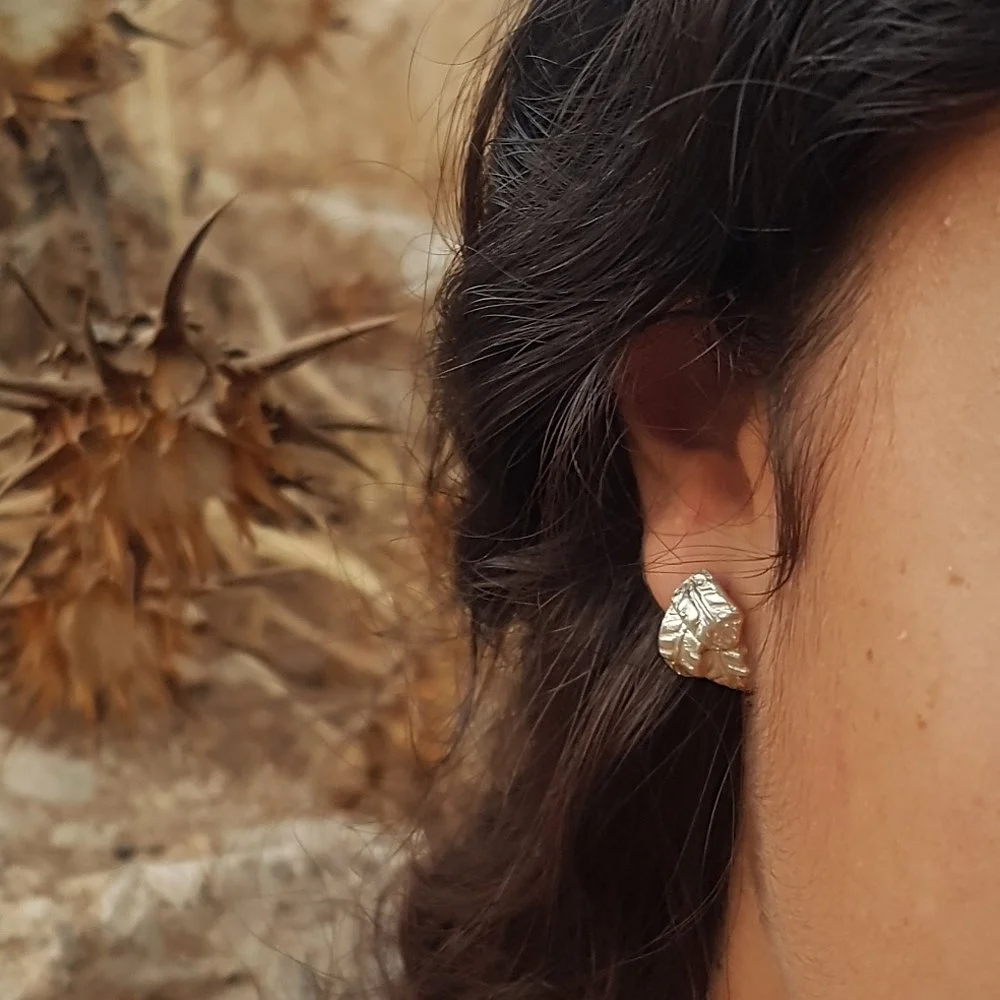
Statement Stud Earrings: recycled sterling silver, one agora coins from Israel [discontinued] 1967 and 1968.
Keystones generally refer to the final, wedge-shaped stones laid at the top of architectural arches through which the weight of these structures is evenly distributed. A keystone is therefore ‘key’ to the structural integrity of the arch - arches being most commonly used as portals between spaces (for instance, as doorways or windows). It can therefore be said that keystones represent the most integral parts of transitional and transformational spaces, they literally and figuratively stand at the interface between spaces.
In these earrings Malki Studio has hammered silver beyond its elastic limits, causing cracks and rough edges to appear on the surface of the metal. These “ruined” keystones hold within them discontinued one agora coins from Israel from 1967 and 1968, citing the myriad ancient and contemporary processes of transformation that Jews and Israelis have lived through. Each of the coins depicts wheat, a ‘key’ plant species native to the Middle East that has an enduring significance as a symbol of prosperity inextricably linked with several cultural and religious traditions in these lands.
Dimensions: approximately 5 cm x 4 cm x 1.6 cm
*Please note: these are large but lightweight earrings and come with large earring backs to assist with comfortable wear.

Brooch: recycled and ethically sourced sterling silver, titanium, Israeli 5 Lira coin from 1978.
The velvety brushed silver backing of this brooch was made of a single piece of recycled sterling silver hammered by hand into a thin sheet with irregular, organically shaped and textured, and cracked edges. The treatment of the metal was produced by deliberately hammering the metal beyond its elastic limits (normally, metal is repeatedly heated to renew its elasticity as it is shaped). This stressed, cracked, and textured aesthetic is reflective of the feelings of Jews and Israelis worldwide in context of the current social and political climate. Hope is found in the centre of the brooch, where a proud and fearsome lion roars. This lion is the face of the discontinued 5 Lira coin from 1978. It is a replica of the 8th Century BCE Shema Seal found in Megiddo, attributed to King Jeroboam II, the longest reigning monarch of the ancient Jewish Kingdom. The lion is a symbol of our people’s strength, resilience, and courage, and serves as archeological evidence of our ongoing connection to the land of Israel.
Brooch dimensions: approximately 6.3cm wide x 8cm high x 1cm in depth.
*Please note that the titanium pin that fastens this brooch is 1.5mm thick and therefore works best on looser woven fabrics such as linen or wool.

Pendant and chain: Responsibly sourced sterling silver, responsibly sourced fine silver, 10 agora coin (Israel - 1979), sterling silver curb chain.
The front face of this 1978-1979 Israeli ten agora coin depicts a date palm. The date palm is associated with the notion of abundance and agricultural heritage of the Middle East. In Israel, it represents the country’s connection to its ancient Jewish roots as well as its more recent agricultural achievements. In the Jewish calendar, which follows a lunar cycle rather than a solar one, the aluminium coin was minted in the year 5739.
Set in an elegantly simple pendant featuring twisted fine silver wire, this is a lightweight and comfortable piece for everyday wear.
Pendant diameter: 2.5cm.
Chain length: 45cm.
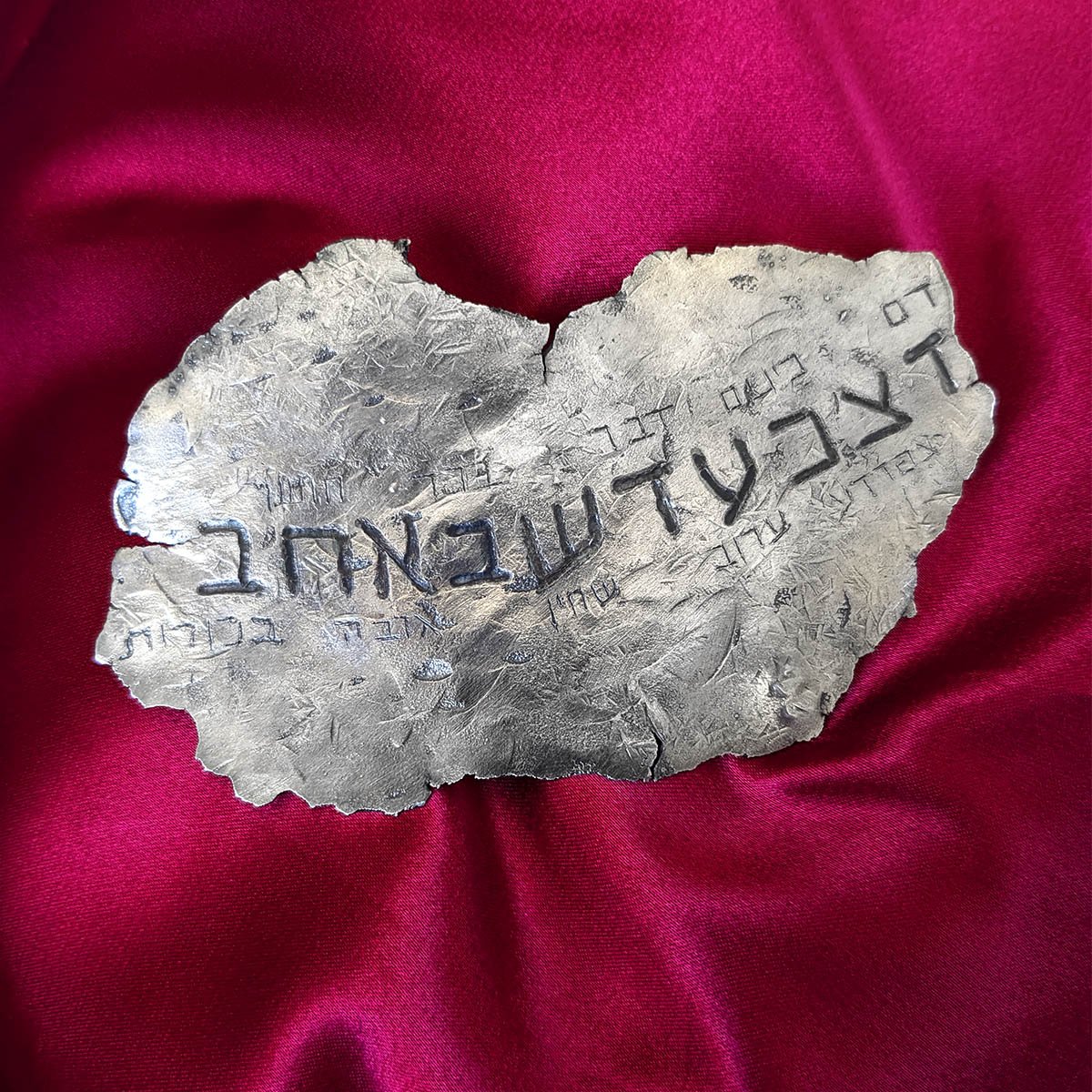
Brooch: Recycled sterling silver, titanium pin.
In Hebrew, the word sarid—which means ‘relic’—is etymologically linked with the Hebrew word for survival. This brooch cites both of these connotations, simultaneously referring to the long history and survival of the Jewish people.
The textual component of this brooch is derived from the Passover Seder, specifically the ten plagues inflicted upon the Ancient Egyptians in the pursuit of Jewish freedom from slavery.
This piece was exhibited in Elemental, an exhibition by the Jewellery and Metalsmiths Group of Queensland (JMGQ), held in 2024 at the Metcalfe Gallery in the Brisbane Institute of Art.
Brooch dimensions: 10cm x 6cm x 0.5cm
*Please note that the titanium pin that fastens this brooch is 1.5mm thick and therefore works best on looser woven fabrics such as linen or wool.

Pendant and chain: responsibly sourced and repurposed sterling silver, responsibly sourced fine silver, responsibly sourced 9 karat gold, ethically sourced natural 1.45 carat zircon from Rubyvale, Queensland, Israeli 50 shekel coin from 1984, sterling silver chain.
The bronze 50 shekel coin that this pendant centers on is a replica of a Judean coin from the Great Jewish Revolt against the Roman Empire between the years 66 and 70 in the Common Era. The coin depicts a Lulav and Etrog, which is set of plants that has symbolised the Jewish holiday of Sukkot for millennia. Sukkot is a holiday that celebrates God’s protection of the Jewish people throughout our history, the Jewish connection to nature and agriculture in our native land, and our unity as a people.
Adorning this pendant is a radiant yellow natural zircon which was ethically sourced from Rubyvale in Queensland. The gem references the light of the sun and the outdoors, as Sukkot is a holiday in which Jewish people spend seven days in makeshift outdoor shelters supported by palm leaves and colourful decorations.
Chain length: 45cm.
Pendant dimensions: 6.5cm x 3.3cm x 1.5cm.
Pendant weight: 21.9 grams.
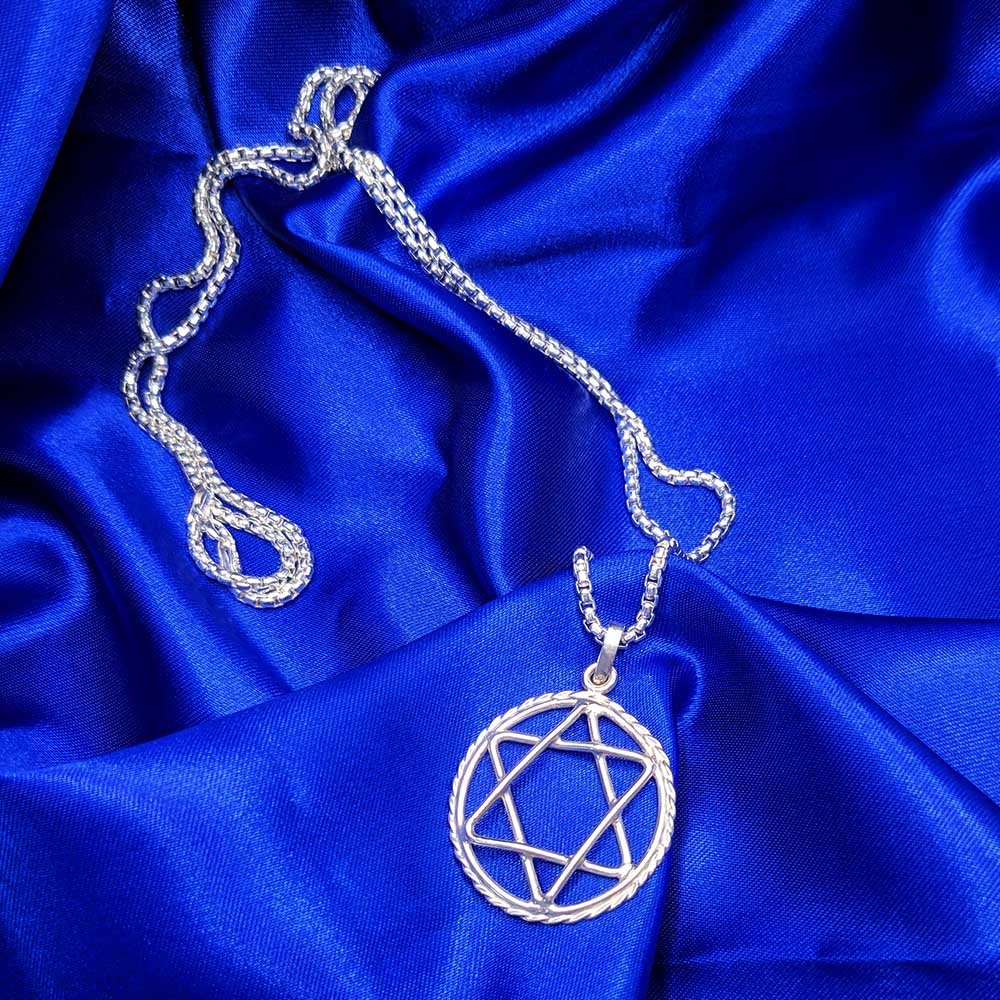
Star of David pendant and chain: responsibly sourced sterling silver, responsibly sourced fine silver.
This Magen David pendant has been completely handmade in our studio from responsibly sourced sterling and fine (pure) silver. We offer this classic Star of David pendant and box chain in hope that it brings the wearer pride, strength, and comfort.
Pendant dimensions: 3cm x 2.7cm.
Chain length: 60cm.

Pendant and Chain: Responsibly sourced sterling silver, responsibly sourced fine silver, half lira coin (Israel, 1967), sterling silver snake chain.
The front face of this 1967 Israeli half lira coin depicts the official Israeli emblem, a Menorah flanked by two olive branches. For Jews, the symbolism of the Israeli emblem is clear. The Menorah speaks to the survival of the Jewish people in the face of hardship, the light of hope that pierces the darkness threatening to consume us. The olive branch is a somewhat complex symbol derived from the biblical narrative of Noa’s Ark. Certainly, the olive branch symbolises peace. It bears emphasising that the desire for peace is not only a fundamental Jewish value but is enshrined (through this emblem) into the ethos of the state of Israel. The olive branch is also a Jewish symbol for the trust we place in God, a trust forged through millennia of Jews persisting through wars, antisemitism, and genocidal regimes. Finally, the olive branch is a Jewish symbol for our home, as the plant itself is native to the Mediterranean and features in the imagery and narratives of our traditions and customs.
Malki Studio have created this pendant and chain in hope that the wearer is empowered by our ancient culture and in remembrance of our eternal value of being a peace seeking and hopeful people.
Pendant diameter: 2.7cm.
Chain length: 45cm.
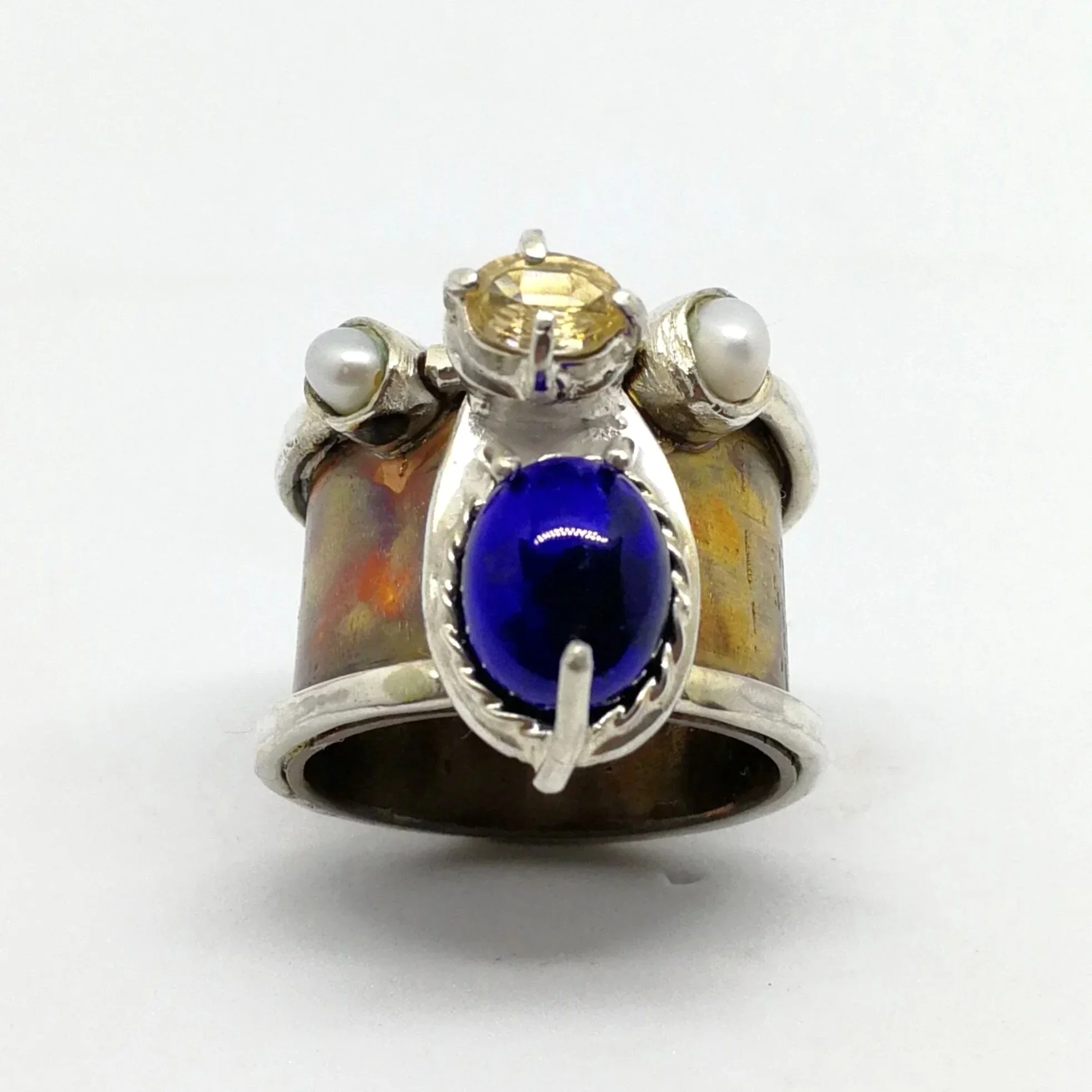
*This piece has been sold. If you would like something similar, please contact us to start a custom order. Together, we’ll create something just for you!
Ring: responsibly sourced sterling silver, copper, lapis lazuli, ethically sourced natural Australian zircon, cultured freshwater pearls.
This one-of-a-kind ring was inspired by the qualities of the materials themselves, especially their colour and lustre. The ring features a multicoloured oxidised copper shank that has been stabilised to both preserve the colour and also for easier wear. In stark contrast to the copper, the sterling silver border of the ring is reflective and cool, set with a sensual mixture of natural gemstones and cultured pearls. The lapis cabochon is a vivid blue that stands out beautifully against the copper shank and the champagne coloured ethically mined zircon (not cubic zirconia) from the Gemfields in Queensland. The two pearls provide a soft glow that compliments the copper and lapis while contrasting with the clarity of the zircon.
Size: R 1/2 (9). See our Sizing Guide.
Dimensions: 2.9cm x 3.4cm x 2.2cm.

Necklace: hand carved nephrite jade, responsibly sourced 14 karat yellow gold beads, pure silk cord, responsibly sourced sterling silver, responsibly sourced fine (pure) silver.
חי (Chai) is the Hebrew word for ‘life’ and a widely recognised and cherished Jewish symbol. Encapsulated within this small two letter word is an important belief shared by Jews worldwide: that all life is precious, valuable, and bursting with meaning.
Hand carved into nephrite jade and set into a fine (pure) silver setting, this necklace is intended to signify the wearer’s strength, hope, and love of life. Accented with gold and strung on pure silk, this is a quietly luxurious and comfortable necklace.
Necklace length: 52cm

Ring: responsibly sourced sterling silver and cultured freshwater pearls.
Shabbat is a unique sterling silver and freshwater pearls ring made by lost wax casting. It features two tall stems crowned by lustrous pearls that create a glow reminiscent of the Shabbat candles of the Jewish tradition.
This piece was selected for artisan Collects (2022), a collaborative initiative between Malki Studio and artisan Gallery that invited collectors to explore jewellery as an art form. For more information, please click here.
Size: M 1/2 (6.5). See our Sizing Guide.
Dimensions: 3.4cm x 5cm x 1.1cm.

Fibula brooch: responsibly sourced sterling silver, ethically sourced Utah (USA) variscite, repurposed cultured freshwater pearl, repurposed carnelian cabochon, ethically sourced parti sapphire from the Queensland Gemfields.
The Menorah Fibula is a large brooch created in celebration of our Jewish culture and history, especially through its symbolism of shining the light of hope, warmth, and strength in dark and uncertain times. The seven branched candelabrum is an ancient Jewish symbol tied inextricably to our people’s history, religion, culture, community, and land.
The presentation of the Menorah in the form of a fibula references the history of our family in North Africa. In Algeria, Jews and Muslims alike traditionally wore large silver fibula brooches to fasten clothing and suspend other items of jewellery in accordance with varied, rich, and spiritually significant customs.
This piece was selected for artisan Collects (2022), a collaborative initiative between Malki Studio and artisan Gallery that invited collectors to explore jewellery as an art form. For more information, please click here.
Approximate dimensions: 5.8cm x 11cm.
*Please note that the silver pin that fastens this fibula is 1.2mm thick and therefore works best on looser woven fabrics such as linen or wool.

*This piece has been sold. If you would like something similar, please contact us to start a custom order. Together, we’ll create something just for you!
Pendant and chain: recycled and responsibly sourced sterling silver, 8.5 carat concave cut fluorite, sterling silver chain.
The evil eye is a motif shared by many cultures around the Mediterranean Sea and predates the monotheistic religions (Judaism, Christianity, and Islam). It has nevertheless been incorporated and adapted into the mystic traditions of these religions and thus remains a dominant motif shared by most cultures in the Mediterranean.
Approached from a Jewish, North African perspective, this pendant is intended as an offer of empathy and protection to its wearer, acting as a sentinel and witness to one’s hardships.
Chain length: 45cm.
Pendant dimensions: 5cm x 2.5cm x 1cm.
Pendant weight: 12.9 grams.
Brooch: responsibly sourced 9 karat yellow gold, responsibly sourced sterling silver, heat coloured titanium, Brazilian heliodor (yellow beryl).
While wheat holds great cultural significance for many ancient civilisations, as well as modern empires and nation-states, this life-sustaining plant is native to the Middle East and is nowhere more deeply woven into the fabric of peoplehood than in this region. For Jews, it is difficult to overstate the fundamental role wheat has played in our formation as a people.
Wheat appears in the Torah (the original and foundational version of the Bible) from the very beginning, featuring in the book of Bereshit (Genesis) in the stories of Adam and Chava (Eve) and Yosef (Joseph). It is also one of the Seven Species (Shivat Ha’Minim)—a group of plants mentioned in Dvarim (Deuteronomy) as divine blessings of the Land of Israel. Alongside figs, barley, grapes, pomegranates, olives, and dates, wheat was a staple of the ancient Israelite diet and played a central role in daily life and religious rituals—an importance that continues to this day.
In Judaism, wheat is far more than just a food source—it is a symbol of sustenance, wisdom, divine blessing, and spiritual refinement, deeply intertwined with Jewish history, law, and mysticism.
Dimensions: 9.5 × 13.5cm (approximately 3.74 × 5.31 inches).
*Please note that the titanium pin that fastens this brooch is 1.5mm thick and therefore works best on looser woven fabrics.