
Jewellery as Art: Adornment, Identity, and Memory
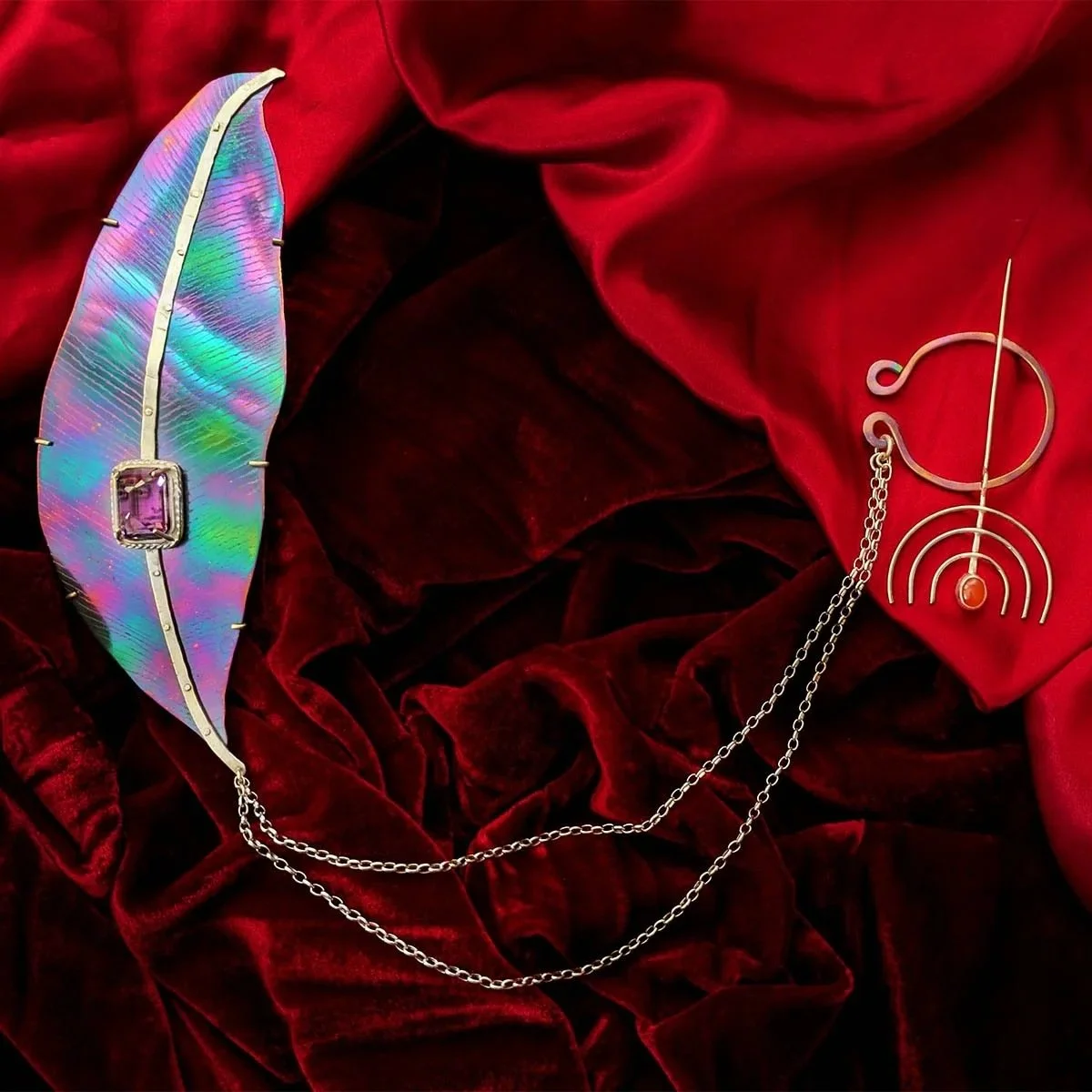
Karti, 2023, Adam Anderson - Malki Studio. Brooch and fibula linked by chain. Heat colored titanium, responsibly sourced sterling silver, acrylic on linen, 12.78 carat Bolivian amethyst, and carnelian cabochon.
The history of jewellery reveals that it has always been more than decoration. Across cultures and eras, it has functioned as portable art—carrying stories of identity, belief, and memory. Whether marking a life transition or a social bond, a piece of jewellery gives physical form to narrative.
Understanding the history and symbolism of jewellery shifts how we see contemporary art jewellery today.
The Origins of Adornment
Perforated shell beads dating back over 142,000 years suggest that early humans used adornment to express belonging and individuality. Ornamentation was therefore not an afterthought of civilisation but an essential element of human expression.
Believed to be the world's oldest jewellery, these perforated Aterian sea snail shells date to about 142,000 years ago. A. Bouzouggar / INSAP.
In ancient Egypt, jewellery combined aesthetics with metaphysics. Gold amulets, scarabs, and inlaid pendants were worn as protective objects and often buried with their owners to accompany them into the afterlife. Later, Roman signet rings expanded jewellery’s function: engraved stones served as signatures to seal documents, transforming personal adornment into both artwork and legal identity.
These early traditions established a pattern still visible today: jewellery operates simultaneously as an aesthetic object, a social language, and a personal archive.
Scarab and mouse amulet finger rings. The lapis lazuli and glazed steatite bezels are mounted on a swivel, allowing them to be flipped and used as a seal. Egypt New Kingdom ca. 1479–1425 B.C.
Ritual Jewellery and Symbolic Form
In medieval Europe, Jewish wedding rings embodied the merging of ritual and artistic symbolism. Rather than simple bands, many were constructed as miniature architectural structures referencing the sacred home and the Temple in Jerusalem. Hebrew inscriptions often encircled the ring, embedding blessing directly into form. The ring was not valued primarily for material worth, but for its conceptual meaning, a sculptural representation of continuity and covenant.
Another significant tradition appears in the work of Jewish silversmiths in Yemen from the eighteenth to early twentieth century. Their filigree was not simply decorative technique but a structural language: silver threads drawn to near-weightlessness were assembled into airy architectural compositions worn on the body. Bridal ornaments and amulets functioned simultaneously as protection, dowry, and visible identity. Rather than emphasizing material value, these works reveal how craftsmanship itself could carry cultural meaning, turning precious metal into a delicate framework for memory and belonging.
Across cultures, such examples demonstrate that jewellery has historically been designed less as fashion and more as symbolic form worn on the body.
Intricate enamel and gold filigree Jewish betrothal wedding ring features an elaborate, hinged bezel designed in the shape of a miniature building, traditionally representing the Temple of Jerusalem or a new home for the couple. 17th - 19th century Europe.
“Jewellery accompanies us and in some cases can become part of our habitus... it functions as a witness to our experiences and as a signifier of aspects of identity... a conduit to transport us to other times, places and people.”
Bernabei, R. & Wallace, J. (2017). Journal of Jewellery Research, Vol. 1: Jewellery and Sense of Self.
Memory, Mortality, and Memento Mori
Mourning Ring, 1661. Enamelled gold with hair ornament, England.
By the seventeenth through nineteenth centuries in Europe, jewellery became deeply intertwined with memory and mortality through memento mori and mourning jewellery. Rings, lockets, and brooches incorporated woven hair from the deceased, miniature portraits, or inscriptions reminding the wearer of life’s fragility. Skulls, urns, and black enamel surfaces appeared not as morbid decoration, but as philosophical reflection, jewellery intended to be contemplated as much as worn.
Hair, in particular, was considered a physical extension of the person. Because it endures after death, it allowed jewellery to function almost as a presence rather than a symbol. These pieces transformed adornment into intimate remembrance objects.
“Personal ornaments are among the most powerful of all material culture symbols. They are the most intimate of possessions, worn on the body and often buried with the dead, acting as a bridge between the biological and the social self.”
Mary Mary Eleanor Striker (2014). The Archaeology of Adornment.
The Contemporary Meaning of Art Jewellery
Today, art jewellery continues this lineage. Contemporary makers draw upon personal and social narratives, material sensitivity, and cultural symbolism to create pieces that function beyond ornament, allowing jewellery to become a conversation between past and present, object and wearer.
For contemporary jewellery collectors, this historical context transforms perception. Jewellery is no longer merely an accessory but a cultural artifact in miniature—sculpture scaled to the body, capable of carrying narrative, identity, and memory simultaneously.
In this sense, jewellery remains one of the most intimate art forms: not placed on a wall or pedestal, but integrated into life itself.


Step into the lineage of art and adornment, and carry your story forward with a piece from our collection.

Necklace: responsibly sourced sterling silver, heat coloured titanium (hook), 10.41 carat ethically sourced Brazilian lavender quartz (concave octagon-cut), 29.75 carat Brazilian lavender quartz pair (pear-cut), dark freshwater pearl, tumbled rose quartz and chevron amethyst beads.
Feminine power and ancient opulence combined, the Ester necklace is titled after Queen Ester, the Jewish queen of Ancient Persia. Queen Ester (Latinized ‘Esther’) is the main character in the story around which the Jewish festival of Purim is based, and stands as a testament to the civilizational alliance between the people of Israel and the people of Persia (modern-day Iran).
This piece captures a sense of regal history, blending raw, tumbled stones with precision-cut gems. The soft hues of rose and lavender quartz are balanced by the deep, rhythmic patterns of chevron amethyst and the inclusion of a dark freshwater pearl, creating a silhouette that feels both ancient and contemporary.
At its centre, a magnificent 10.41 carat Brazilian lavender quartz is claw-set, its concave octagon-cut designed to catch and amplify light from every angle. This is paired with a striking 29.75 carat duo of pear-cut lavender quartz, creating a layered, sculptural aesthetic worthy of its royal namesake.
Details
Artistry: Handmade, one-of-a-kind sculptural necklace
Inspiration: Queen Esther of Ancient Persia
Metals: Responsibly sourced sterling silver (925) and a heat-coloured titanium hook
Primary Gemstone: 10.41 carat ethically sourced Brazilian lavender quartz; concave octagon-cut, claw-set
Accent Gemstones: 29.75 carat (pair) Brazilian lavender quartz; pear-cut, VVS clarity
Beads: Tumbled rose quartz and chevron amethyst strands, cultured freshwater pearl