

Shop the BRAG Edit
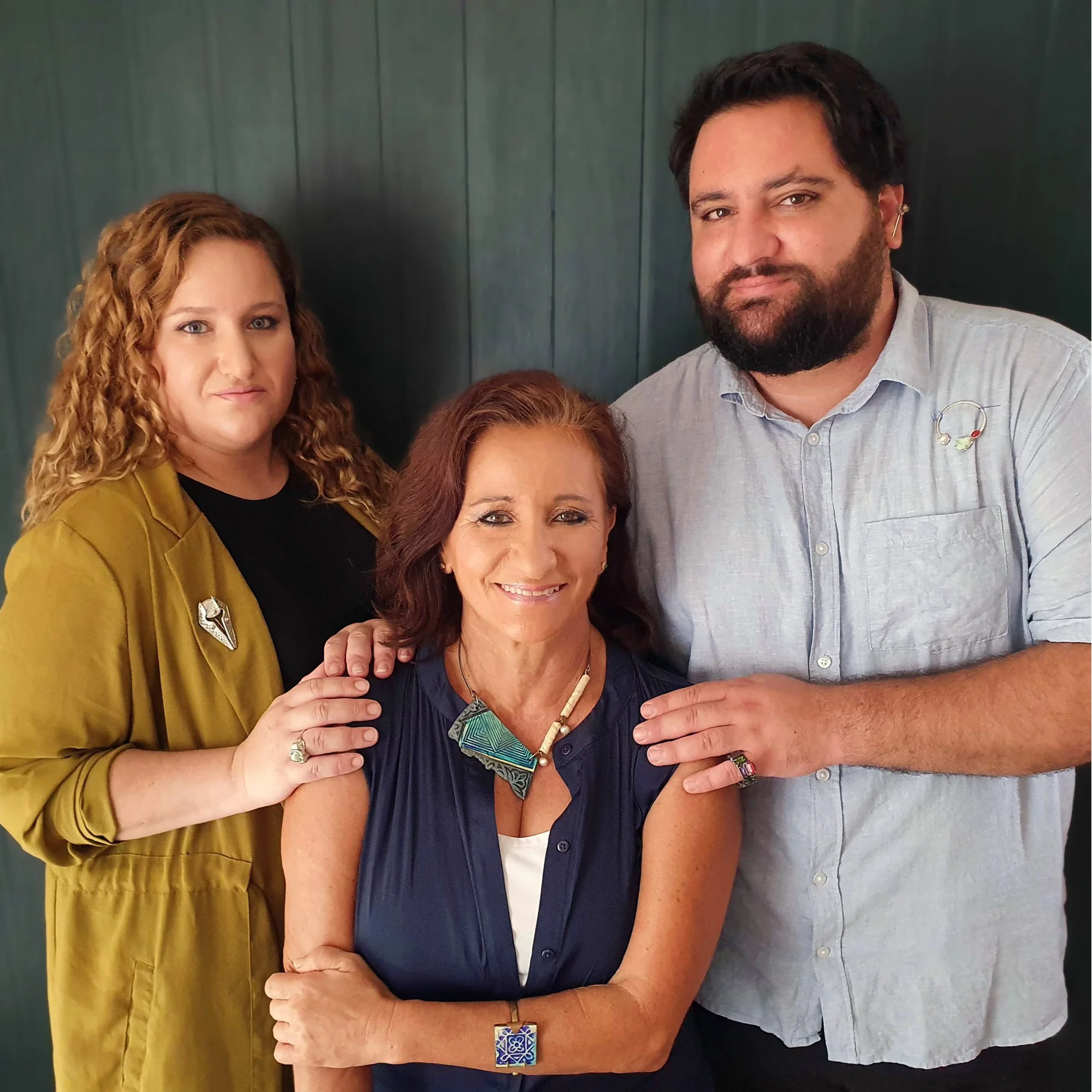
Malki Studio artist Adam Anderson has been in the studio experimenting, pushing colour, and working with some incredible materials.
The result is a series full of electric tones and unique gemstones, curated in collaboration with the Bundaberg Art Gallery.
Available to view and shop in person at BRAG, 1 Barolin St, Bundaberg Central.
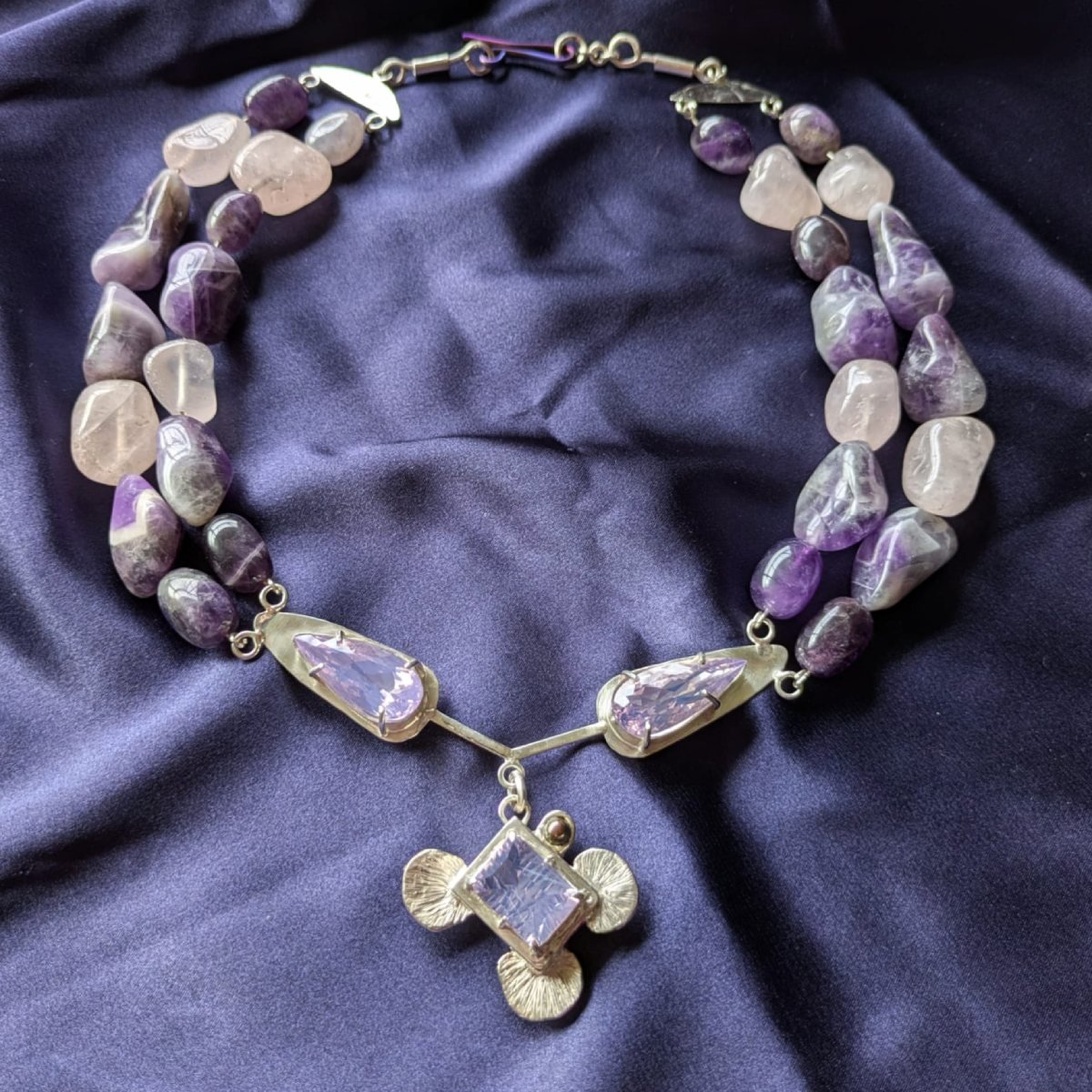
Necklace: responsibly sourced sterling silver, heat coloured titanium (hook), 10.41 carat ethically sourced Brazilian lavender quartz (concave octagon-cut), 29.75 carat Brazilian lavender quartz pair (pear-cut), dark freshwater pearl, tumbled rose quartz and chevron amethyst beads.
Feminine power and ancient opulence combined, the Ester necklace is titled after Queen Ester, the Jewish queen of Ancient Persia. Queen Ester (Latinized ‘Esther’) is the main character in the story around which the Jewish festival of Purim is based, and stands as a testament to the civilizational alliance between the people of Israel and the people of Persia (modern-day Iran).
This piece captures a sense of regal history, blending raw, tumbled stones with precision-cut gems. The soft hues of rose and lavender quartz are balanced by the deep, rhythmic patterns of chevron amethyst and the inclusion of a dark freshwater pearl, creating a silhouette that feels both ancient and contemporary.
At its centre, a magnificent 10.41 carat Brazilian lavender quartz is claw-set, its concave octagon-cut designed to catch and amplify light from every angle. This is paired with a striking 29.75 carat duo of pear-cut lavender quartz, creating a layered, sculptural aesthetic worthy of its royal namesake.
Details
Artistry: Handmade, one-of-a-kind sculptural necklace
Inspiration: Queen Esther of Ancient Persia
Metals: Responsibly sourced sterling silver (925) and a heat-coloured titanium hook
Primary Gemstone: 10.41 carat ethically sourced Brazilian lavender quartz; concave octagon-cut, claw-set
Accent Gemstones: 29.75 carat (pair) Brazilian lavender quartz; pear-cut, VVS clarity
Beads: Tumbled rose quartz and chevron amethyst strands, cultured freshwater pearl
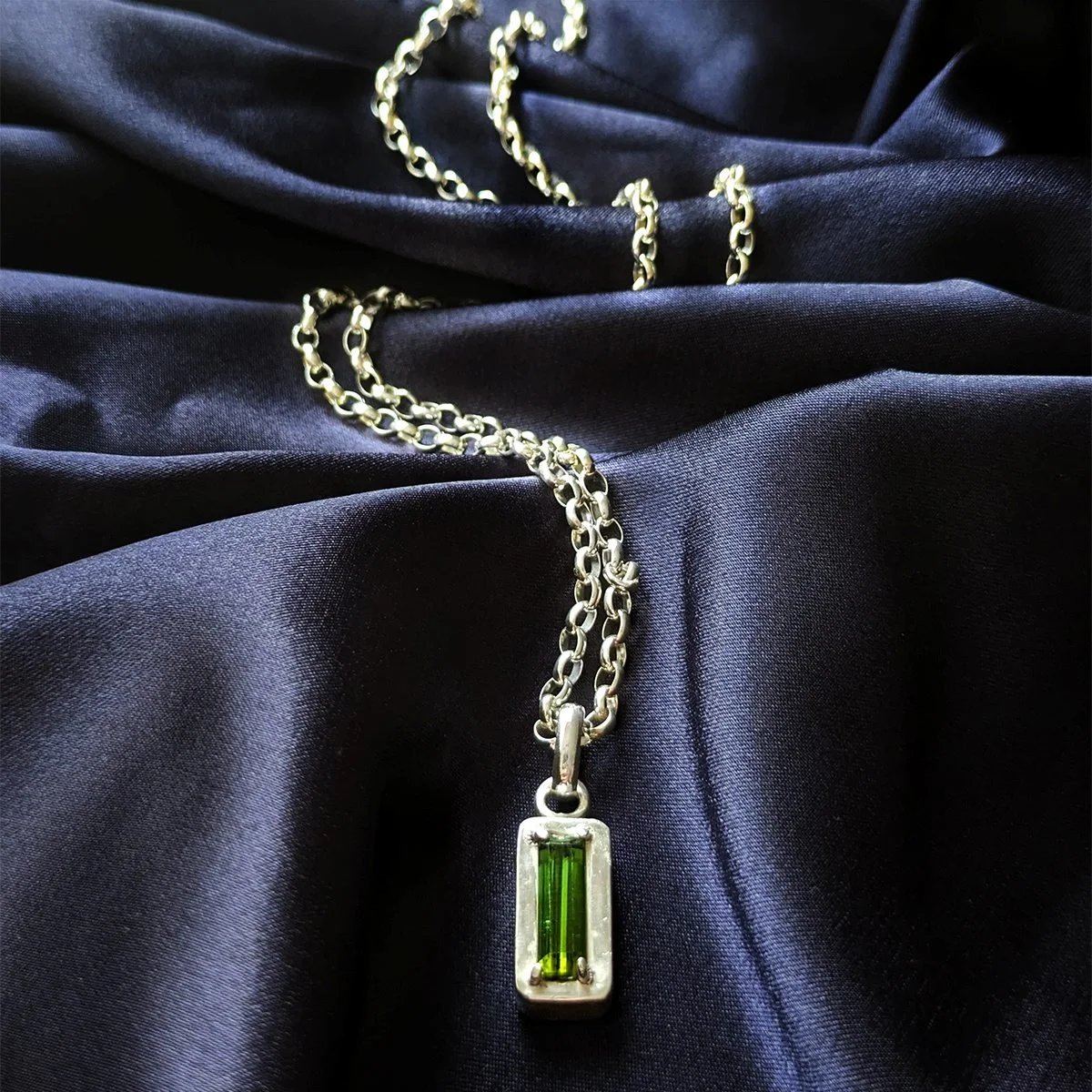
Pendant and chain: fine (pure) silver pendant, sterling silver belcher chain, 1.93 carat emerald-cut green tourmaline from Afghanistan.
Inspired by ancient architectural jewellery, the Ohad pendant features an emerald-cut green tourmaline claw-set on a high fine silver platform. The sterling silver belcher chain is robust, giving Ohad a subtle mixture of soft and hard aesthetics. A balance between weight and delicacy, structure and fluidity.
Details
Metals: responsibly-sourced Fine Silver 999 (pendant) & Sterling Silver 925 (chain)
Design Style: Minimalist, architectural
Gemstone: Green Tourmaline 1.93ct, emerald-cut, claw-setting
Artistry: Handmade one-of-a-kind
Chain: Belcher chain
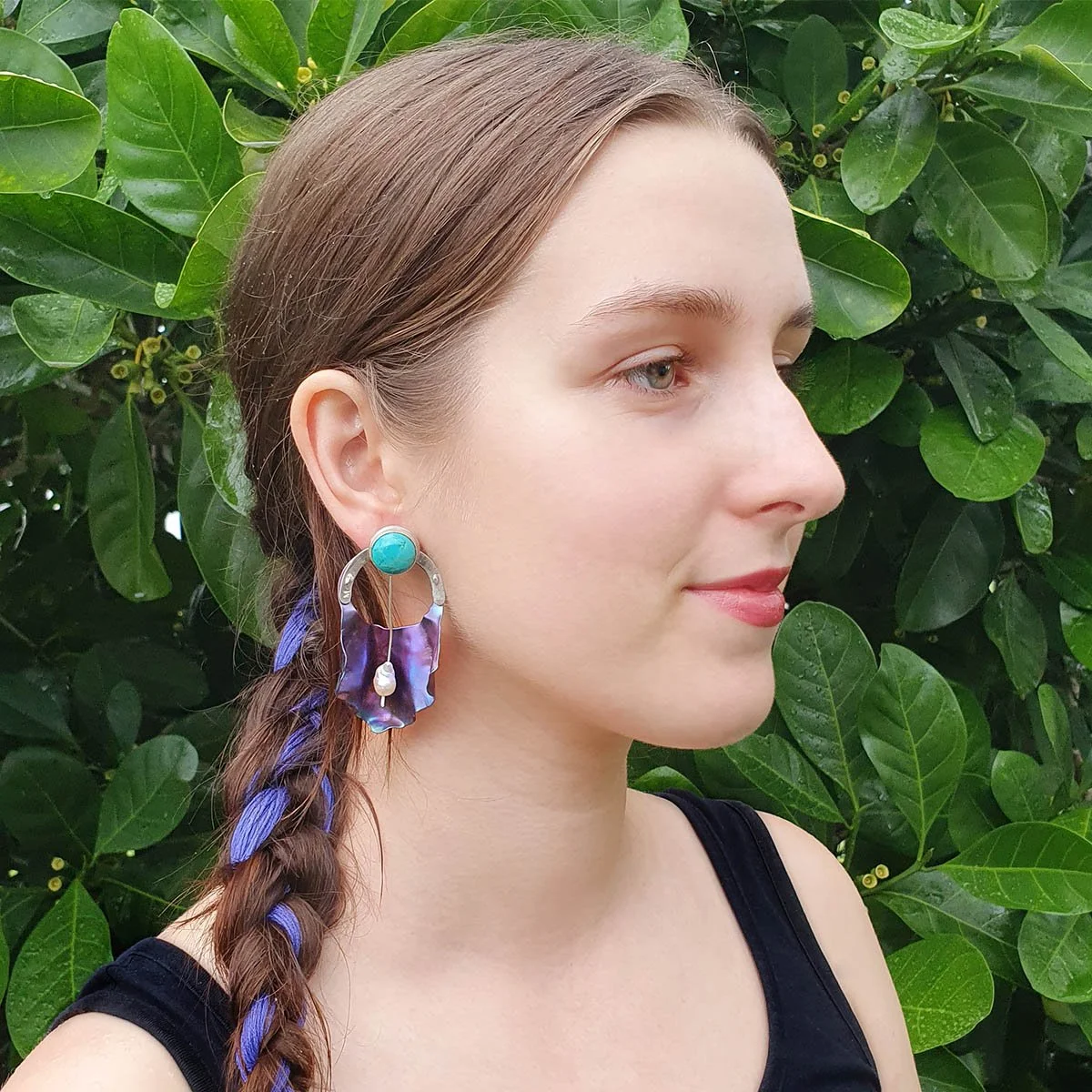
Statement Stud Earrings: responsibly sourced sterling silver, anodised titanium, approximately 17 total carat weight turquoise cabochons, cultured freshwater pearls.
The Martina Earrings draw their form from the graceful, rippling petals of the Gilboa Iris, a rare wildflower known for its complex purples and silky texture. Each earring features a hand-shaped titanium petal, anodised into deep tertiary violets that shift with the light. A slender sterling-silver filament carries a baroque freshwater pearl, echoing the iris’s delicate stamen.
Unlike the natural petal, which narrows inward, these titanium forms open outward, creating a sculptural archway that frames the vivid turquoise cabochon above. The turquoise serves as a symbolic crown—a reference to the brilliant skies and living landscape where the Gilboa Iris blooms.
Named for and modelled by Martina, a cherished member of our family, these earrings celebrate both the rare beauty of the flower and the quiet, enduring elegance she embodies.
Dimensions: approximately 7 cm x 3 cm (each)

Ring: responsibly sourced 18kt yellow gold, responsibly sourced sterling silver, responsibly sourced fine silver, heat coloured titanium, ruby, cultured freshwater pearl.
A tribute to the splendour of Byzantium, Byzanti is a handcrafted ring featuring a beautiful pinkish-red ruby, a cultured freshwater pearl, and heat coloured titanium. These luminous elements are set against a blend of 18kt yellow gold with responsibly sourced sterling silver, creating a harmonious contrast of warmth and brilliance.
Drawing from Byzantine artistry, this piece embodies the empire’s opulence—where gold flowed like sunlight, pearls symbolised purity and prestige, and richly coloured gemstones conveyed power. The ruby’s deep pinkish-red accentuates the ring’s historic ties to wealth and devotion.
Ring size: N (6 3/4). See our Sizing Guide.
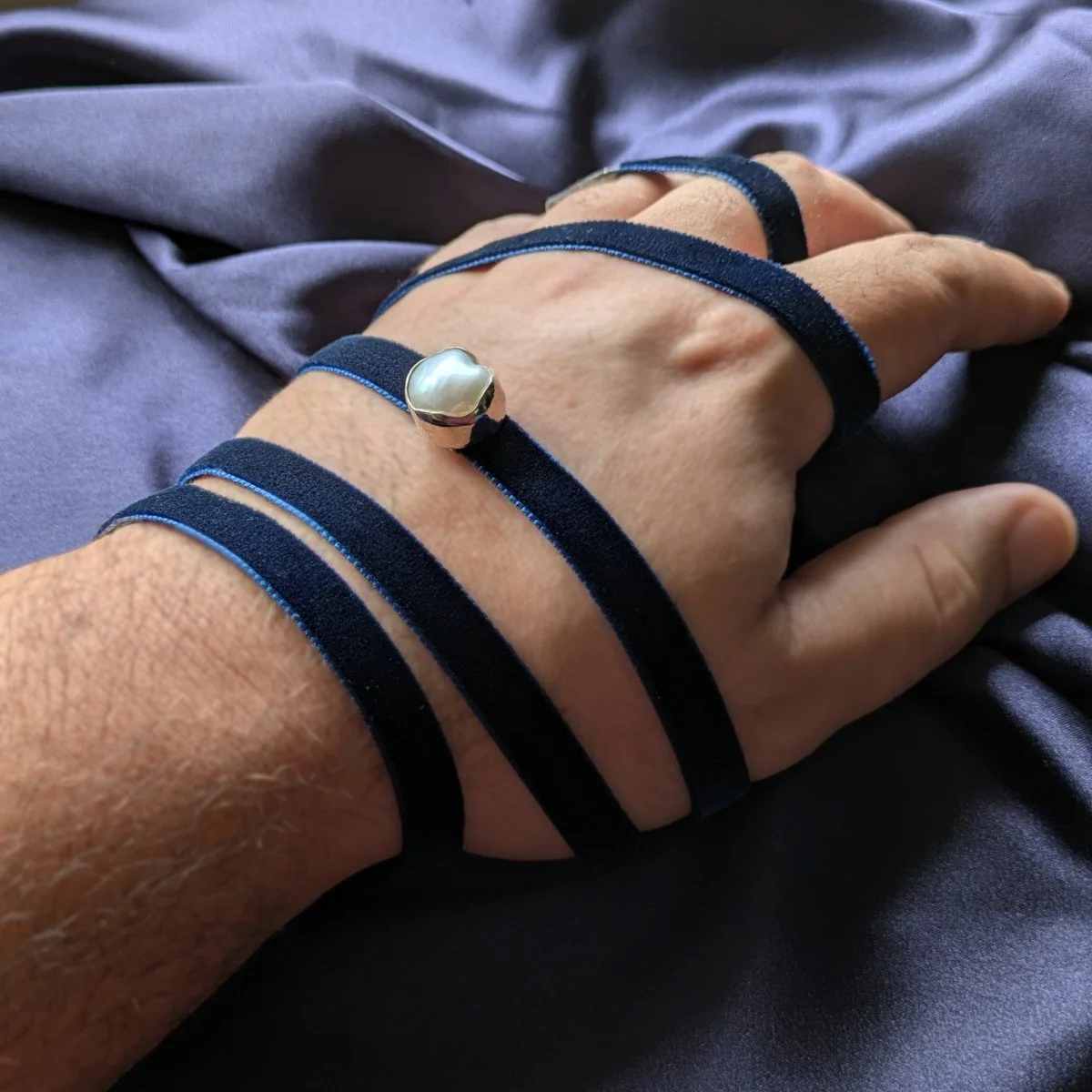
Choker necklace/headband: cultured freshwater pearl, responsibly-sourced sterling silver, responsibly-sourced fine silver, aluminium, velvet.
This choker necklace was inspired by a Leonardo da Vinci painting, La Belle Ferronnière. A Ferronnière is a head adornment that was popular during the Renaissance. It can be worn as a necklace or as a headband in homage to the da Vinci painting.
Details:
Design: Versatile choker necklace that can also be worn as a headband
Inspiration: Renaissance adornments and Leonardo da Vinci’s La Belle Ferronnière
Gemstone: Cultured freshwater pearl
Metal: Responsibly sourced sterling silver (925) and fine silver (999), aluminium
Ribbon: Navy-blue velvet

Drop Earrings: titanium, responsibly sourced sterling silver, responsibly sourced 14kt gold, ethically sourced 1.95ct (3.9ct combined) Brazilian garnets, cultured freshwater pearls.
The richly coloured Diatom earrings are a one-of-a-kind marriage of heat coloured titanium, sterling silver, and 14kt gold. The earrings are inspired by the photosynthetic microorganisms known as diatoms, which produce up to half of the world’s oxygen. The shells of some species of diatoms are almost crystalline in appearance, with sharp geometric shapes that are stunningly complex.
Each earring is based on etched titanium that has been heat coloured in saturated hues of green and pinkish purple. The deep red of the ethically sourced garnets is a complimentary colour to the titanium, and contrasts wonderfully with the brushed sterling silver settings that feature twisted wire and rivets. Dangling from the 14kt gold are two dark cultured freshwater pearls, with slightly mismatched undertones of green on one pearl, and bronze on the other.
Dimensions: approximately 3 cm x 3.5 cm x 2 cm

Ring: responsibly sourced sterling silver, titanium, cultured freshwater pearl.
This one-of-a-kind ring comes from our Orbit Collection. The ring speaks to the experience of marvelling at the night sky, its aerodynamic tail expressing the desire to somehow “go there,” to be in the sky, not just as an observer.
This piece was selected for artisan Collects (2022), a collaborative initiative between Malki Studio and artisan Gallery that invited collectors to explore jewellery as an art form. For more information, please click here.
Size: V (10.5). See our Sizing Guide.
Dimensions: 2.4cm x 4.1cm x 3.1cm.
You Might Also Like

Brooch: responsibly sourced sterling silver, anodised titanium, pear cut yellow-green tourmaline, stainless steel double pin.
Key is a shallow relief profile bust of a symbolic man. The form was constructed by chasing and repousse (using various shaped tools to hammer the surface of the metal from both above and below) from a 0.8mm sheet of titanium. The resulting sculpture was anodised into iridescent purple, copper, and blue hues, the dominant colour varying depending on angle of viewing and lighting conditions. Anchoring the profile is a yellow-green elongated pear cut tourmaline, which adds charge, tension, and contrast to the already sensual form of the figure, set in silver. At the base of the profile, the first letter of the Hebrew alphabet, א (aleph) is stamped and engraved back into the raw titanium.
The brooch cites the threshold of new beginnings, the ambivalent fear and attraction that attend fundamental change, and the embodied sensations that anticipate a coming touch.
Brooch dimensions: (H) 10.5cm x (W) 6cm.
Please note: this brooch is affixed with a vertical, 0.9mm stainless streel double pin, suitable for most fabrics.

Brooch: responsibly sourced sterling silver.
This unique architectural brooch comes from our Ancient Tomorrow Collection. It is an elegant statement piece, inspired by the architecture of Paris’s Notre Dame cathedral. Referencing its flying buttress, rose window, intricate details and overall uniqueness.
The unisex brooch was cast using the lost wax casting method and has a sterling silver pin and catch.
Notre Dame was exhibited in Queensland’s Parliament House in 2022 as a showcase of Queensland’s artistic excellence, curated by artisan Gallery. This piece was also selected for artisan Collects (2022), a collaborative initiative between Malki Studio and artisan Gallery that invited collectors to explore jewellery as an art form. For more information, please click here.
Dimensions: 3.2cm x 5.5cm x 1.3cm.

Brooch: responsibly sourced 18 karat gold, responsibly sourced sterling silver, heat coloured titanium, responsibly sourced fine silver, ethically sourced 2.4 carat London blue topaz from Brazil.
The Nova brooch was made in response to the October 7th massacres that occurred in Israel, in particular the Nova Music Festival. Nova takes the form of a flower, a purple variant of the poppy anemone which is native to the Mediterranean region which includes Israel. The poppy anemone is Israel’s favourite flower, the red variant being Israel’s national flower. Following the massacre at the Nova Music Festival, the Israeli community has created individual memorials for those who were murdered, including planting flowers that honour the dead. Not surprisingly, a favourite among these has been the poppy anemone, or Kalanit (in Hebrew).
Malki Studio has created this brooch to express the ongoing grief of Jewish and Israeli people, and offer it as a solemn example of our people’s deep connection to our land, culture, history, religion, and each other.
Nova was exhibited as part of the Intimate Worlds exhibition at NorthSite Contemporary Arts in Cairns. Occurring between August and October in 2024, the exhibition “is about celebrating materiality and process. The artists featured in ‘Intimate Worlds’ have a profound respect for their materials, and their work reflects a deep curiosity and dedication to their craft.”
Brooch dimensions: approximately 7cm x 7.5cm x 3.5cm.
*Please note that the titanium pin that fastens this brooch is 1.5mm thick and therefore works best on looser woven fabrics.

Brooch: responsibly sourced sterling silver, 5.4ct boulder opal from Winton (Queensland), textured black clay.
This brooch was especially created for display in the Bundaberg Regional Art Gallery’s shop for the Linda Jackson: Opal exhibition. A retrospective exhibition of Linda Jackson’s “opal era,” this exhibition features a vivid collection of the famous Australian fashion designer’s iconic and colourful garments and textiles from the late 1970’s to the present.
In homage to Jackson’s elegant yet simple silhouettes as well as the wild, unique, and arresting aesthetic of opals, Malki Studio artist Ariella Anderson has streamlined the components of this brooch. Asymmetrical but harmonious, the brooch features a stunning Winton boulder opal and textured black clay set directly onto sterling silver. These components highlight the contrast between the gleaming white metal and the earthy black clay and colourful gemstone, which display an oceanic blue play of colour set against the dark body tones of the ironstone matrix. The brooch recalls the dramatic beauty of the Australian land and the importance of preserving its unique and precious resources.

Brooch: responsibly sourced sterling silver, heat coloured titanium, ethically sourced 4.46 carat white topaz from Mount Surprise, Queensland.
The fig tree is one of the first plants mentioned in Bereshit (Genesis) in the Torah, when its leaves were used by Adam and Eve in the Garden of Eden to clothe themselves immediately after eating of the Tree of Knowledge (suggesting that perhaps the Tree of Knowledge was a fig tree). Fig trees are also one of the Seven Species—a group of edible plants mentioned in the book of Dvarim as natural endowments of the land of Israel. Alongside wheat, barley, grapes, pomegranates, olives, and dates, the fig was considered by the Ancient Jewish Kingdoms and the Israelites as staples of their diet. The first fruits of the Seven Species were also used as offerings traditionally given to the Jewish Temple in Jerusalem by worshippers—the wood of the fig tree serving as fuel for the Temple’s Eternal Flame. In the Ancient Jewish holiday of Tu Be’Shvat, also known as the New Year for Trees, dried figs are traditionally eaten as part of the celebration.
These are but some of the significances of the fig tree to the Jewish people. That the native species of the Levant are so enmeshed within the foundation of Jews as an ethnoreligious group speaks strongly to our connection to the land of Israel. This brooch is an homage to that connection.
Eden was exhibited as part of the Intimate Worlds exhibition at NorthSite Contemporary Arts in Cairns. Occurring between August and October in 2024, the exhibition “is about celebrating materiality and process. The artists featured in ‘Intimate Worlds’ have a profound respect for their materials, and their work reflects a deep curiosity and dedication to their craft.”
Dimensions: 15.5 × 11cm (approximately 6.10 × 4.33 inches).
*Please note that the titanium pin that fastens this brooch is 1.5mm thick and therefore works best on looser woven fabrics.

Brooch: responsibly sourced 9 karat yellow gold, responsibly sourced sterling silver, heat coloured titanium, Brazilian heliodor (yellow beryl).
While wheat holds great cultural significance for many ancient civilisations, as well as modern empires and nation-states, this life-sustaining plant is native to the Middle East and is nowhere more deeply woven into the fabric of peoplehood than in this region. For Jews, it is difficult to overstate the fundamental role wheat has played in our formation as a people.
Wheat appears in the Torah (the original and foundational version of the Bible) from the very beginning, featuring in the book of Bereshit (Genesis) in the stories of Adam and Chava (Eve) and Yosef (Joseph). It is also one of the Seven Species (Shivat Ha’Minim)—a group of plants mentioned in Dvarim (Deuteronomy) as divine blessings of the Land of Israel. Alongside figs, barley, grapes, pomegranates, olives, and dates, wheat was a staple of the ancient Israelite diet and played a central role in daily life and religious rituals—an importance that continues to this day.
In Judaism, wheat is far more than just a food source—it is a symbol of sustenance, wisdom, divine blessing, and spiritual refinement, deeply intertwined with Jewish history, law, and mysticism.
Dimensions: 9.5 × 13.5cm (approximately 3.74 × 5.31 inches).
*Please note that the titanium pin that fastens this brooch is 1.5mm thick and therefore works best on looser woven fabrics.
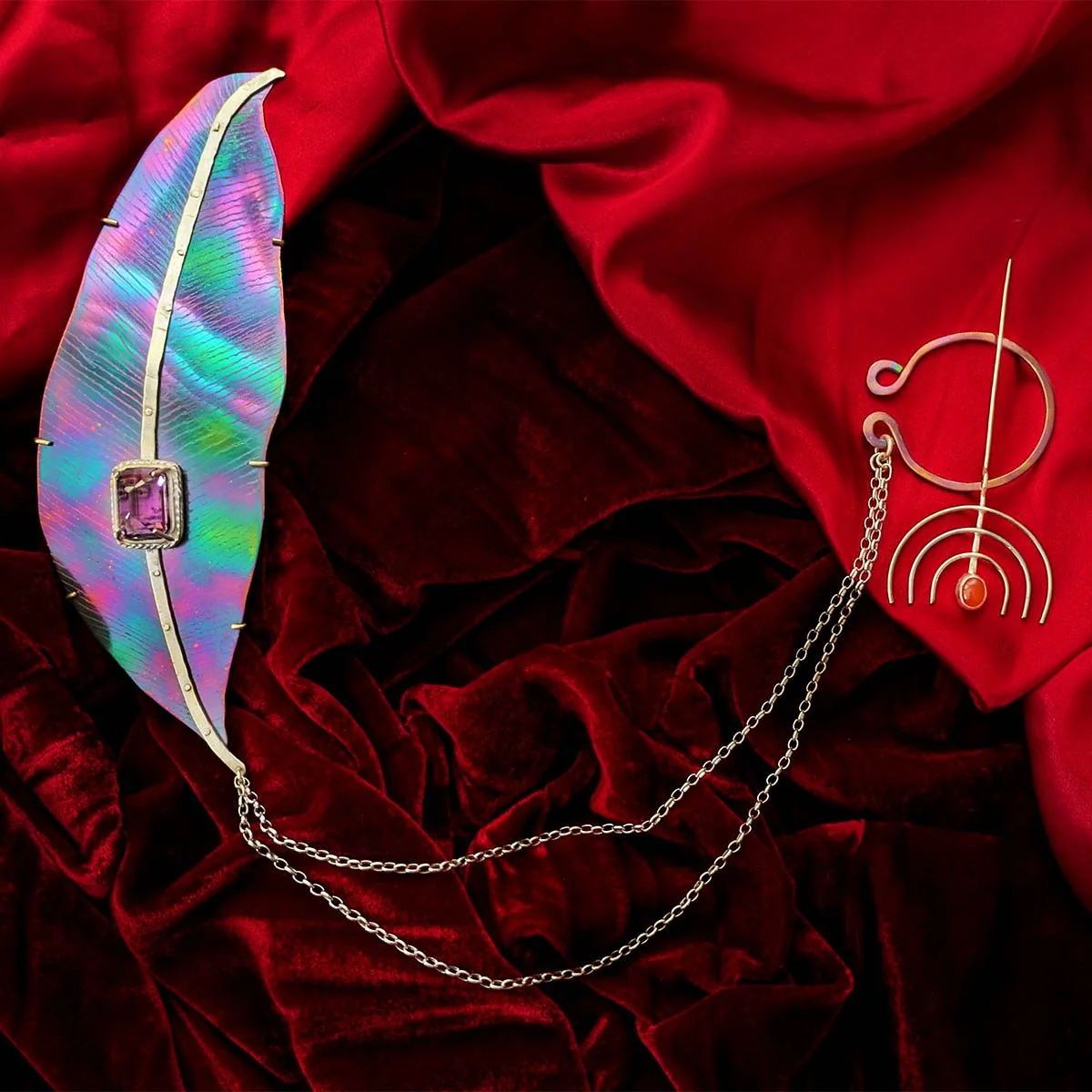
Brooch and fibula: responsibly sourced sterling silver, heat coloured titanium, emerald cut 12.78 carat Bolivian amethyst, carnelian cabochon, acrylic paint on linen, varnish, sterling silver chain.
Karti is essentially composed of two pins which are attached through a chain. Its name is a reference to one of the prayers and symbols of the Jewish New Year (Rosh Hashana), which represents divine protection from the malevolent forces that threaten the Jewish people.
Karti was made in the immediate aftermath of the October 7 massacres in Israel, and speaks especially of the strength of Jewish women.
Its design cites the traditional jewellery produced and worn by Jews in North Africa prior to our ethnic cleansing in the middle of the 20th Century. Traditionally, Jewish women would have worn two fibula brooches—one on each shoulder—which fastened garments. A chain traditionally connected between the brooches and suspended beads or other ornaments with various symbolic meanings.
In Karti, the fibula takes the form of an inverted Menorah, an ancient symbol of Jewish continuity, set with a carnelian cabochon, carnelian being a traditional material used throughout the Middle East and North Africa. Meanwhile, the titanium and silver brooch is shaped like an oversized olive leaf, representing the Jewish connection to the land of Israel as well as peace. The Bolivian amethyst on this brooch was set upside down, enabling the pavilion facets to fracture and multiply the miniature portrait (painted by hand using acrylic paint on linen) that is set behind the gem. The portrait allegorically depicts Jewish women, with facial features drawn from multiple images of female members of our family as well as Anne Frank and Golda Meir.
Karti was exhibited as part of the Intimate Worlds exhibition at NorthSite Contemporary Arts in Cairns. Occurring between August and October in 2024, the exhibition “is about celebrating materiality and process. The artists featured in ‘Intimate Worlds’ have a profound respect for their materials, and their work reflects a deep curiosity and dedication to their craft.” The work was similarly exhibited as a response exhibition to the Phantom superhero comic in 2023 in the Bundaberg Regional Art Gallery as part of the Phantom Response exhibition.
Adam also published a magazine article which included text and images of his work, including Karti, in Yad Mizrah Magazine. Click here to view the article.
Approximate dimensions:
Olive leaf brooch: 18cm x 6cm.
Fibula: 8.5cm x 4cm.
Chain length: 22cm.

Brooch: recycled and ethically sourced sterling silver, titanium, Israeli 5 Lira coin from 1978.
The velvety brushed silver backing of this brooch was made of a single piece of recycled sterling silver hammered by hand into a thin sheet with irregular, organically shaped and textured, and cracked edges. The treatment of the metal was produced by deliberately hammering the metal beyond its elastic limits (normally, metal is repeatedly heated to renew its elasticity as it is shaped). This stressed, cracked, and textured aesthetic is reflective of the feelings of Jews and Israelis worldwide in context of the current social and political climate. Hope is found in the centre of the brooch, where a proud and fearsome lion roars. This lion is the face of the discontinued 5 Lira coin from 1978. It is a replica of the 8th Century BCE Shema Seal found in Megiddo, attributed to King Jeroboam II, the longest reigning monarch of the ancient Jewish Kingdom. The lion is a symbol of our people’s strength, resilience, and courage, and serves as archeological evidence of our ongoing connection to the land of Israel.
Brooch dimensions: approximately 6.3cm wide x 8cm high x 1cm in depth.
*Please note that the titanium pin that fastens this brooch is 1.5mm thick and therefore works best on looser woven fabrics such as linen or wool.
Bangle bracelet: responsibly-sourced sterling silver, aluminium, titanium, 1.62 carat emerald-cut Turkish diaspore (gemstone).
Path speaks to self-determination, mapping the complex topography of a person’s interior life. This one-of-a-kind sculptural bangle captures the essence of choices made, alternate realities, and the quiet illuminations that define our personal histories.
The core features a band of twice heat-coloured titanium, where iridescent hues and engraved linework reflect the maze-like trajectories of our lived experience. Framed by similarly engraved aluminium and featuring a sterling silver setting positioned prominently in front of the titanium, the piece is a gesture of taking ownership of one’s own life.
Crowning this wearable landscape is a little-known gemstone: an emerald-cut diaspore (also known as zultanite). The gem is claw-set atop a raised silver platform, framed by a delicate twisted wire border. This remarkable stone possesses a rare and natural ability to change colour from this soft mint green to a pastel yellow as it absorbs different wavelengths of light.
Details
Artistry: Handmade, one-of-a-kind sculptural bangle
Form: Wide, layered bands with engraved topographical lines
Inspiration: Personal talisman
Metals: Responsibly sourced sterling silver (925), aluminium, twice heat-coloured titanium
Gemstone: Diaspore (zultanite) 1.62 carat, emerald-cut, claw-setting